 UniveWiki
FOUNDATIONS OF MACHINE LEARNING
Introduction
Neural networks and and machine learning.
What is Artificial Intelligence?
TIP
There is no universally accepted definition. The ability to perform well in an intelligence test ().
Operational definition: procedure to measure intelligence. Boring, 1961
The turing test Does the machine acts like a human?
Alan Turing
ChatGPT cannot pass the turing test.
To pass the test the Ai needs these skills:
- Natural language processing (to interact with humans)
- Knowledge representation (to memorize things)
- Automated reasoning (to use the knowledge to answer questions)
- Machine learning (to adapt to new circumstances and detect patterns)
- Perception (Computer vision and speech recognition)
- Robotics (to manipulate objects and move around)
AI: an interdisciplinary edeavor:
Cognitive science, Neurobiology, Philosophy, Sociology, Perception & Learning, Linguitics, Robotics
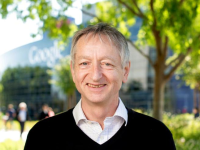
Geoffrey Hinton
He is the father of deep learning
He can solve very difficult problems with ai
Two approaches to make a computer do what you want:
- Intelligent design (classic algorithms. i.e. Djikstra)
- Machine Learning (AI, the modern way of solving problems)
Two modes of thinking: 
- System 1: Fast, conscious, automatic, everyday decisions, error prone
- System 2: Slow, unconscious, effortful, complex decisions, reliable
First successes:
- 1943 McCulloch and Pitts propose a model for an artificial neuron and analyze its properties
- 1949 Donald Hebb proposes a learning mechanims in the brain
- 1950-53 Shannon and Turing work (independently) on chess-playing programs
- 1951 Minsky and Edmonds develop the first "neural" computer
- 1952+ Samuel develops a checker playing game
- 1956 Newell e Simon develop the "Logix Theorist"
- 1957 First attempts at automatic translation (during Cold war)
- 1958 McCarthy invents LIPS (programming language)
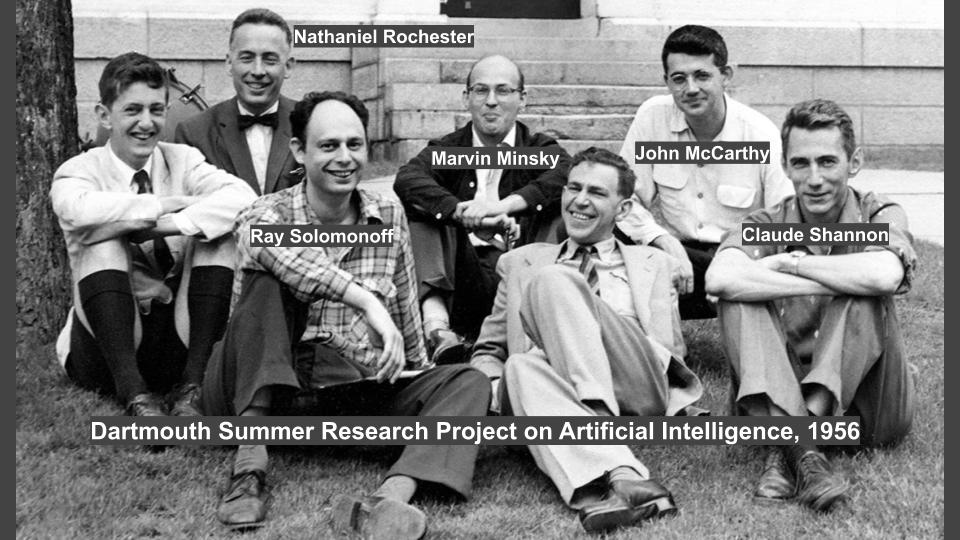
- 1956 DARTMOUTH SUMMER RESEARCH PROJECT ON ARTIFICIAL INTELLIGENCE
- The birth of AI (2 months in summer of research financed by the goverment)
- 1961 Newell and Simon develop General Problem Solver (GPS)
- 1963+ Minsky and students study problems on micro-worlds (es. ANALOGY SHRDLU)
- 1962 Rosenblatt develops the Perceptron, a neural net that learn from examples (classification problem: recognize male vs female). This approach was bad and died:
Failures:
- 1966 Financing to "automatic translation" is project in the USA is canceled
- 1969 Minsky and Papert publish "Perceptrons" where they show that the Rosenblatt model cannot sove some very simple problems
- 1971-72 Cook and Karp develop the computational complexity theory, showing that a lot of problems are "intractable" (NP-complete)
The expert systems are boom:
- 1969 Feigenbaum (Satnford) develop DENDRAL, an ES for making predictions on molecular structures
- MYCIN, an ES with some 450 rules for the diagnosis of infectious diseases
- 1979 PROSPECTOR, an Expert System (ES) for mineral exploration